.svg)


Kitchen Tiles: Should Your Backsplash Match the Countertop or Cabinets?
ByNandana Priya

Wed , Sep 16 , 2026

Read Time: 5 Min


 Copied!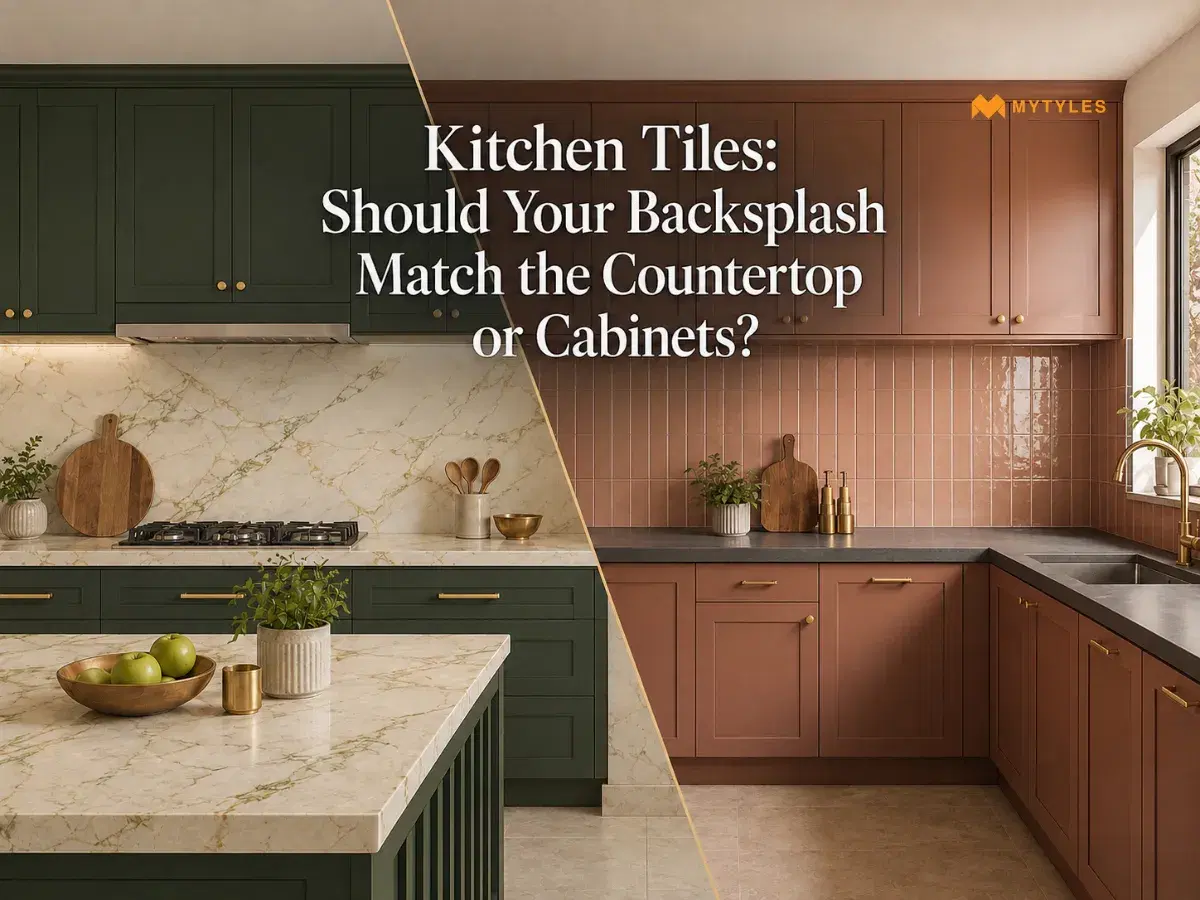
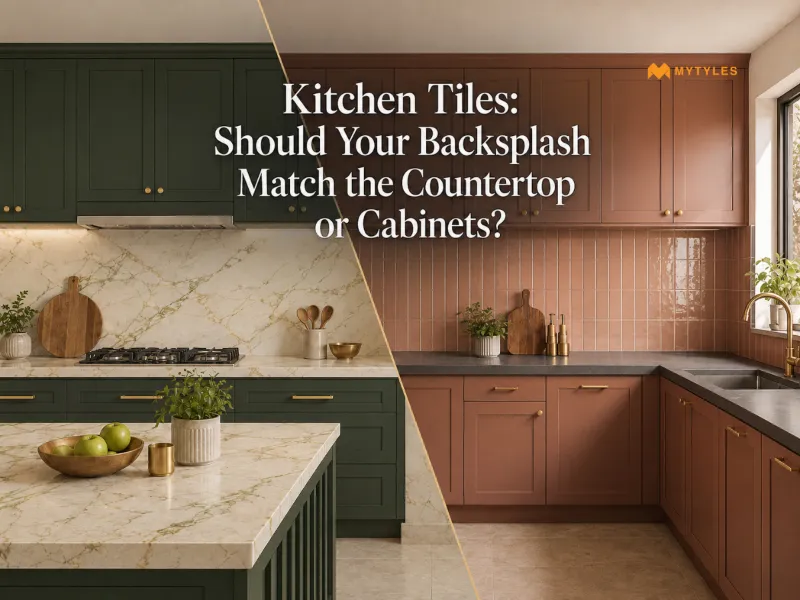
Should the backsplash tile match the countertop, match the cabinets, or neither? It is one of the most common questions people run into when choosing kitchen tile. Somehow, this one section of tile is supposed to make sense of both.
Most people assume the backsplash has to pick a side, matching the countertop for a seamless look or matching the cabinets to tie the room together. But that is not really how it works.
Kitchen backsplash tiles can coordinate with one surface, sit apart from the other, or quietly connect the two through colour, undertone, or texture. There is no single correct pairing, only a direction that suits how the kitchen is used and how it feels to be in it.
So which one is right for your kitchen? Matching the countertop. Matching the cabinets. Or neither. The most suitable one depends on a few things, and this is where it gets interesting.
Backsplash Tiles That Match the Countertop
Backsplash Tiles That Match the Countertop.webp)
What Counts as a Match?
A backsplash matching the countertop does not mean finding an identical tile. Often it is just about staying in the same colour family, undertone, or pattern rather than copying it outright. A backsplash chosen this way tends to feel like part of the counter rather than a separate layer stuck onto the wall. Even a slightly different shade can still read as coordinated.
When This Works Best
This direction tends to work well when the countertop already carries a noticeable pattern, such as veining or flecks. Repeating the same tones on the wall as your kitchen countertop can help the backsplash and countertop create a more continuous look. This approach can suit compact kitchens, open layouts, and spaces where the goal is a calm, uncluttered look.
Avoiding a Flat, Overly Uniform Look
The risk with matching too closely is a flat, uneventful result. One way to reduce this effect is by changing something other than the colour. A different tile shape, a textured or matt finish against a glossy counter, or a grout shade that stands slightly apart can prevent all the surfaces from blending into one indistinct block. Layout also helps, since a herringbone or vertical stack can add movement even when the kitchen tiles stay close in colour to the countertop.
Matching With Veined Countertops
With veined countertops specifically, it generally helps to keep the backsplash simpler. A busy pattern paired with a strong veined marble look or marble kitchen tile countertop can feel like a lot going on. Sticking to a plainer tile in a matching undertone and letting the countertop carry the visual interest tends to work better.
Note: Before finalising a backsplash tile that matches the countertop, view the tile and countertop samples together under the kitchen's actual lighting. It is also worth checking backsplash suitability, cleaning needs, and how grout joints will align with the countertop edge.
Backsplash Tiles That Match the Cabinets
Backsplash Tiles That Match the Cabinets (2).webp)
How Cabinet Colour Carries Over to the Backsplash
Matching the cabinets works differently from matching the countertop. Instead of following a pattern or vein, it usually means picking up the same colour family or undertone as the kitchen cabinets. A backsplash that matches the cabinets tends to create a stronger colour connection between the cabinetry and the wall surface.
The Risk of the Backsplash Losing Definition
An exact colour match between the backsplash and cabinets can sometimes cause the backsplash tile to lose definition, especially if the finishes are similar too. It generally helps to keep some contrast in texture or sheen, even when the colours are close, so the wall tile still looks like its own surface rather than an extension of the cabinetry.
Working With Bold or Dark Cabinet Colours
With darker cabinets, a lighter or more neutral tile can help balance the kitchen. Lighter cabinets can pair with a darker tile if the overall scheme supports it. The right backsplash colour for kitchen cabinets, in either case, usually comes down to how much contrast the rest of the room already has.
Contrasting the Backsplash With Cabinets and Countertop
Contrasting the Backsplash With Cabinets and Countertop.webp)
This contrasting direction is not really one choice; it is two. The backsplash can either stand apart from both surfaces on purpose, or it can borrow a little from each without fully matching either one.
What Contrast Means Here
A contrasting kitchen backsplash is not trying to blend in with the cabinets or the countertop. It is meant to stand out, whether through colour, pattern, or texture. This can work well when the cabinets and countertop are fairly neutral on their own.
What a Bridge Backsplash Does
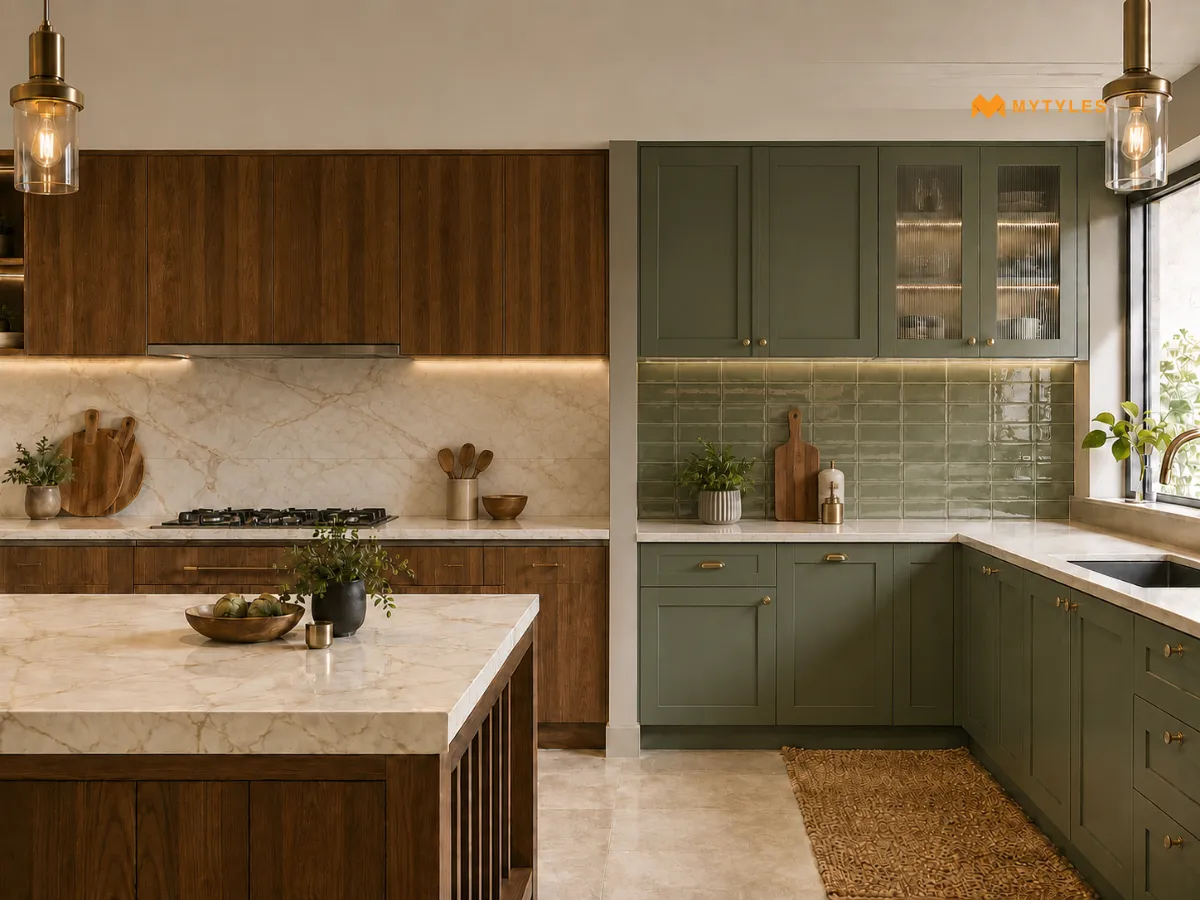
A bridge backsplash takes a different approach. Instead of standing apart, it picks up a secondary colour, undertone, or pattern detail that already exists somewhere in the kitchen, such as in the cabinets, the countertop, or both. The result connects the two surfaces indirectly. It tends to feel more cohesive than full contrast, while still giving the wall its own identity.
Contrast vs Bridge: Which Fits Your Kitchen
Contrast tends to suit kitchens where the cabinets and countertop are already quite neutral, and there is room for one surface to carry some personality. A bridge tends to suit kitchens where the cabinets and countertop already have some colour or pattern of their own, and the goal is harmony rather than a new focal point.
Factors to Consider Before Choosing
A few practical points are worth checking before settling on a direction.
- In a smaller kitchen, or one with limited natural light, a closely coordinated backsplash can create a quieter overall look.
- Checking the cabinet and countertop undertones against the tile sample early helps avoid a mismatch that only becomes obvious once everything is installed.
- A countertop with visible veining or flecks often works better with a simpler backsplash, while a plain countertop leaves more room to bring in a patterned or textured tile.
- It also helps to decide early whether the backsplash should stay quiet and coordinated or stand out as its own feature, since that helps narrow down kitchen tile choices.
The Right Direction Is the One That Fits Your Kitchen
There is no single rule a backsplash has to follow. It really comes down to how you want the kitchen to feel and how much attention you want the wall to draw. Matching the countertop keeps the space looking calm and continuous. Matching the cabinets brings the upper and lower halves of the room closer together. And a backsplash that contrasts, sometimes directly and sometimes through a shared colour thread, gives the wall a personality of its own. Ready to compare options for your kitchen? Browse MyTyles' kitchen tile collection, or visit the experience centre to compare the tiles in person before you decide.

Should Kitchen Backsplash Tiles Match The Countertop Or Cabinets?

There is no rule that kitchen backsplash tiles have to match either one. They can coordinate with the countertop, follow the cabinet colour, or contrast with both. Start by looking at the colours and undertones already present. If the countertop has strong veining or a pattern, keeping the backsplash simpler can prevent the surfaces from competing with each other.
How Do I Match A Backsplash With A Quartz Countertop?
Start by looking at the countertop’s undertone, flecks, and veining rather than only its main colour. The backsplash can pick up one of these smaller details to create a connection without matching exactly. If the quartz already has a noticeable pattern, a simpler backsplash can help keep the overall combination balanced.
What Backsplash Works With White Kitchen Cabinets?
White kitchen cabinets give you plenty of room to decide how noticeable you want the backsplash to be. A similar light shade creates a more coordinated look, while beige, grey, or a stronger colour introduces contrast. Look at the countertop as well, since its colour and undertone can help bring the cabinets and backsplash together.
How Do I Choose A Backsplash For Grey Kitchen Cabinets?
When considering grey kitchen cabinets with backsplash combinations, first identify whether the grey has warm or cool undertones. White and off-white can create clearer contrast, while related grey tones produce a more tonal scheme. A different colour can also work when you want the backsplash to stand apart. Compare the cabinet, countertop, and tile samples together before deciding.
When Does A Contrasting Kitchen Backsplash Work Well?
A contrasting kitchen backsplash can work particularly well when the cabinets and countertop are relatively neutral, and the wall has room for a stronger colour, pattern, or texture. Contrast does not have to mean choosing the opposite colour. The backsplash can simply be noticeably different while still repeating a smaller colour or undertone found elsewhere in the kitchen.
What Backsplash Should I Choose With A Granite Countertop?
For a granite countertop backsplash, first look at how much movement, speckling, and colour variation the granite already has. A visually active countertop can be paired with a simpler backsplash that picks up one of its secondary tones. With quieter granite, there may be more room for pattern or texture. Viewing both samples together helps reveal undertone differences before installation.
Are Neutral Kitchen Backsplash Tiles A Good Option?
Neutral kitchen backsplash tiles can work when you want the cabinets or countertop to carry more of the visual interest. White, off-white, beige, cream, and grey can coordinate with a range of surrounding finishes, but the undertones still matter. Instead of choosing a neutral tile in isolation, compare it directly with the countertop, cabinets, grout, and kitchen lighting.

ABOUT THE AUTHOR
Nandana Priya
I have a strong interest in design and creativity, and I enjoy translating the world of tiles and their trends into engaging reads. Focusing on creating well-researched content that feels meaningful to readers has always been my first priority. I bring a growing understanding of research, design, and digital marketing into my writing, with a focus on clarity, relevance, and thoughtful storytelling.